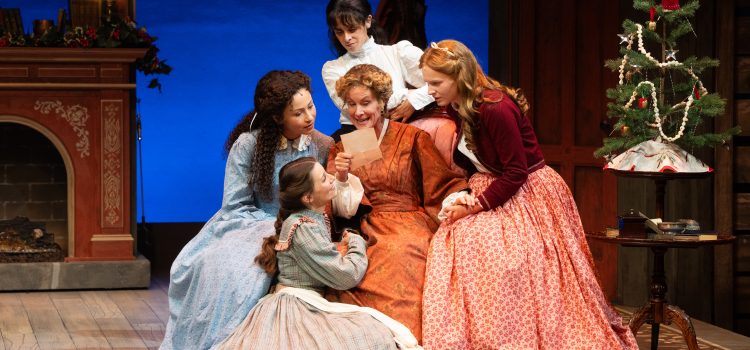
By Lynn Venhaus

Let’s hear it for the boys! Those scrappy underdogs who win over many hearts nightly in the high voltage “Newsies” have taken over the Muny stage with their own versions of the American Dream, spreading hopeful cheer.

This crowd-pleasing production triumphs as a fresh, fantastic, fun take on the David vs. Goliath true story of the two-week Newsboys Strike of 1899, with catchy pop hooks and powerful anthems by legendary composer Alan Menken.

From the introductory group number’s camaraderie in “Carrying the Banner” to the unifying, pivotal “The World Will Know,” the optimistic call for solidarity in “Seize the Day,” and the rousing “Once and For All,” the cast of triple-threat talents boast contagious enthusiasm and can-do spirit.

Menken, winner of eight Academy Awards, wrote seven new songs for the stage show, and won his first-ever Tony Award. Jack Feldman wrote the lyrics. Their exhilarating blend of power pop, vaudeville and swinging melodies resonates.

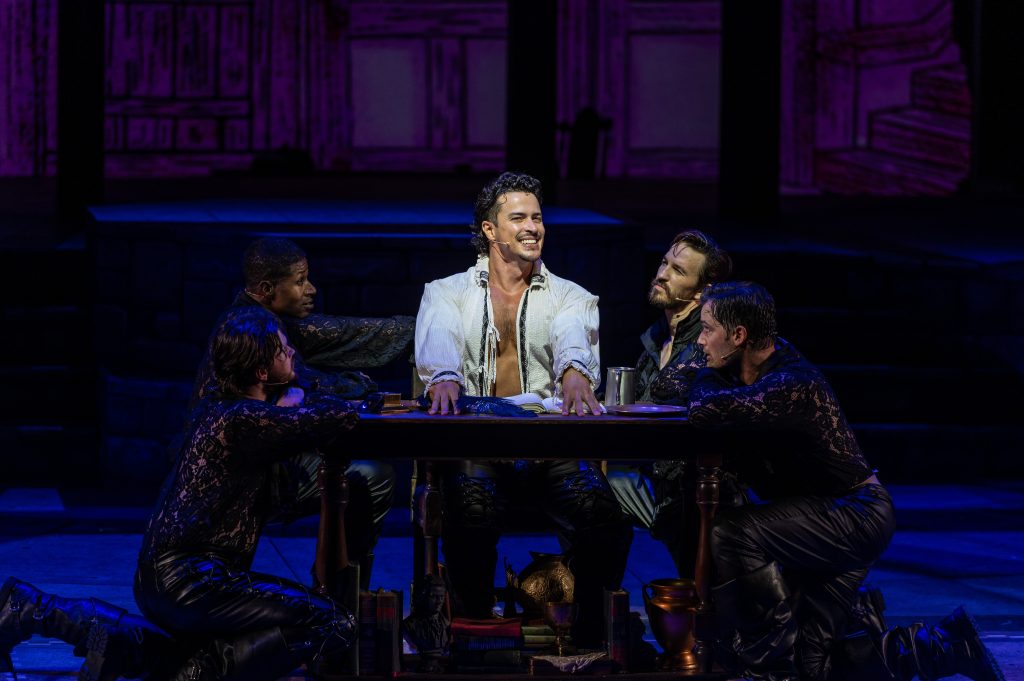
From left: Bryce Williams, Jack Roden, Jaron Bentley and Kayla Pecchioni in the 2026 Muny production of Disney’s “Newsies.” Photo by Phillip Hamer

An ebullient ensemble of the finest caliber fortifies the right-over-might aspects by wearing their hearts on their sleeves — and not just showing tremendous athletic skills in synchronized dance numbers choreographed by Richard J. Hinds. (Perhaps you recall his unforgettable can-can number from last summer’s “La Cage Aux Folles”?).

Their physical stamina – especially in the July heat – is incredible, showing how adept at tap, ballet and acrobatic moves they are. Through his fluid direction, Denis Jones integrates the energetic dance numbers with heart-tugging emotional storytelling.

Two-time Tony nominee and recipient of three St. Louis Theater Circle Awards, Jones has put his signature stamp on 12 shows on the Muny stage, and this is another meticulous effort. He reiterates the newsboys’ tight-knit bonds and their “us against the world” mentality.

This 19th century hustle-bustle world of New York City is framed through a gritty lens, with sepia-toned video design by Caite Hevner and rough-and-tumble scenic design by Tijana Bjelajac, which is evocative of that period. Paige Seber’s lighting design and Josh Hummel’s sound design also establish atmosphere.

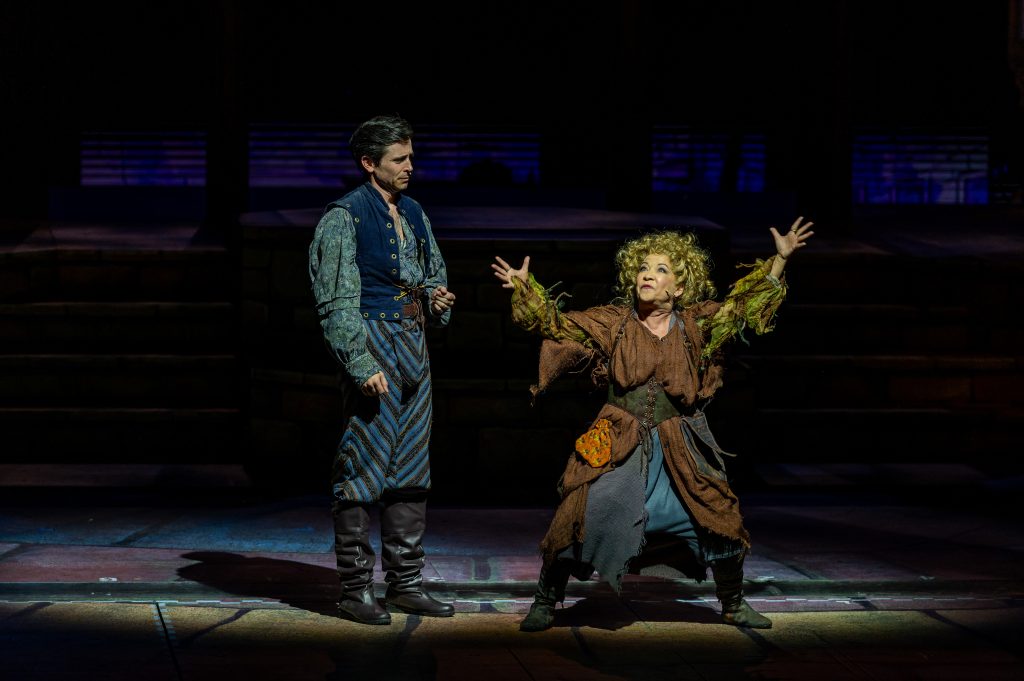
Nolan Almeida in the 2026 Muny production of Disney’s “Newsies.” Photo by Emily Santel, The Muny

Exceptional Music Director Annbritt duChateau conducts a 22-piece orchestra, elevating the emotional underpinnings and keeping a peppy pace for the spry, up-tempo numbers.  

Also popping with personality is the “King of New York” when the Newsies discover how much fun fame and notoriety can be and let loose with a spectacular song and dance number, tapping, leaping and twirling with joy.

The musical continues to strike many chords with modern audiences, ever since the 1992 movie, a box-office dud, drew so much adoration in its VHS and DVD afterlife that Disney adapted the cult phenomenon into a smash 2011 Broadway musical. Christopher Gattelli’s electrifying, airborne choreography also won a Tony.

The nostalgia factor comes into play too. It’s not hard to see why people are drawn to this story – how a ragtag bunch of orphans took on the mighty Joseph Pulitzer, who represented everything villainous about corporate America and the patriarchy – especially unfair labor tactics and unethical business practices.

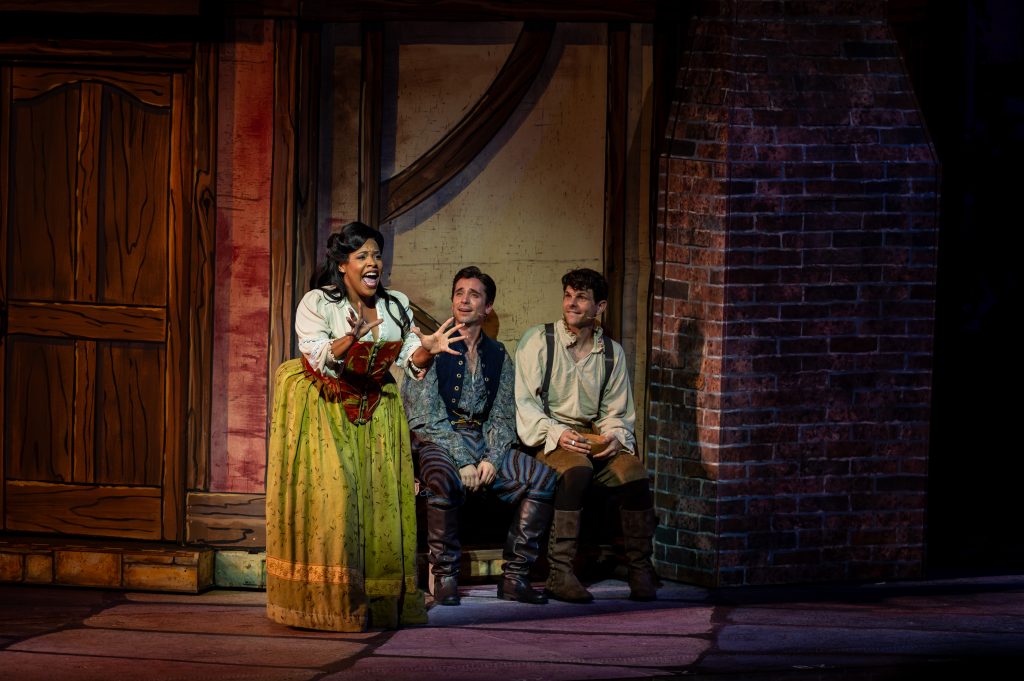
Kayla Pecchioni in the 2026 Muny production of Disney’s “Newsies.” Photo by MaryKatherine Patteson, The Muny

More than a century ago, New York City was home to several publications, including Pulitzer’s New York World, the Herald and The Sun. Newsboys, those resourceful street urchins whose livelihood depended on selling that day’s paper, went on strike when Pulitzer raised the price, reducing their meager wages. Pure greed.

First produced in 2017 at the Muny, it was the Midwest regional premiere after the national tour stopped here in 2016. This musical is a fine example of what our oldest and largest outdoor theater does best — it brings multiple generations together to be uplifted by an inspirational story of courage, friendship and the power of taking a stand. And those high-spirited kids can sure entertain!

Tensions escalate in a book by Harvey Feirstein, adapted from the screenplay by Bob Tzudiker and Noni White. It’s an important history lesson because the labor union movement gained ground as workers were needed for the Industrial Revolution.

Once upon a time, the only way to find out what was going on in the world was to read a newspaper. With the 24/7 relentless news cycle today, it’s a different digital landscape – but the ethical dilemmas remain the same.

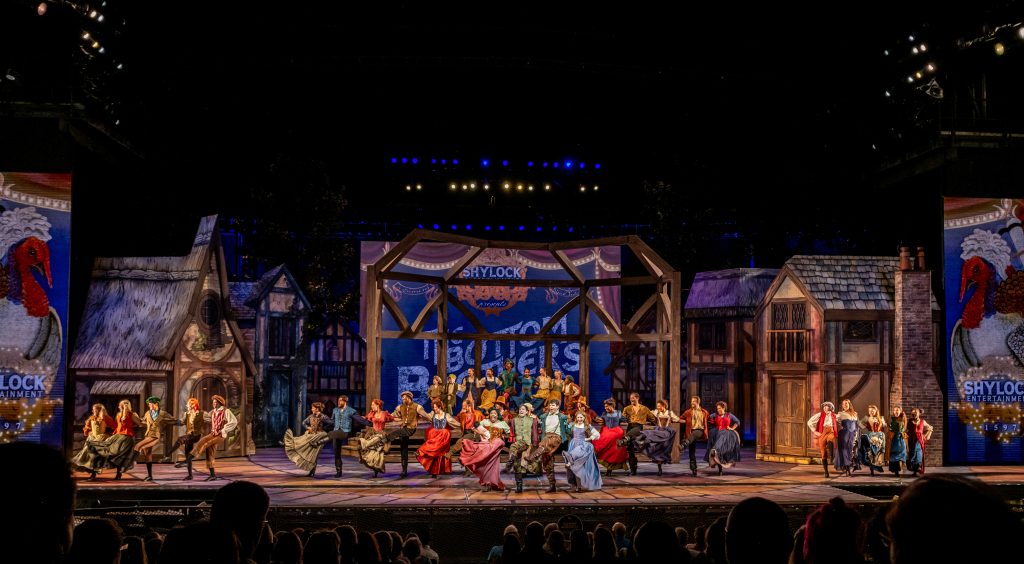
Members of the company of the 2026 Muny production of Disney’s “Newsies.” Photo by Phillip Hamer

Rising star Jack Roden possesses a major wow factor as tough survivor Jack Kelly, the charismatic leader of the strike. He embodies this unlikely heroic figure with ease – and his powerhouse vocals are convincing and clear.

His robust opener “Santa Fe” immediately endeared him, and his duet with fellow newcomer Kayla Pecchioni as spunky reporter Katherine, “Something to Believe In,” is lovely. She makes a good impression in “Watch What Happens.” As their ally, Katherine crusades to show the inequities in factories, slaughterhouses and sweatshops too as the ragamuffins bring the city to a standstill.

Seen last year as encouraging Randall in “Bring It On,” Bryce Williams is formidable sidekick Davey, who pours his heart into the rallying cry. With his keen intelligence and Jack’s street-smarts, they are a good combo.

Kayla Pecchioni and Jack Roden in the 2026 Muny production of Disney’s “Newsies.” Photo by Phillip Hamer

Stealing every scene he’s in is Jaron Bentley as Davey’s little brother, adorable pint-sized Les, immediately winning over the audience through his heart and humor. Seen in The Black Rep’s “Raisin,” Union Avenue Opera’s “Ragtime” and The Rep’s “A Christmas Carol” in recent years, he’s a memorable stage presence.

Another audience favorite is Nolan Almeida as never-say-die Crutchie, a mistreated disabled orphan with a heart of gold. His “Letter from The Refuge” will likely produce a few tears as he details the deplorable conditions at the juvenile reformatory.

It’s always a welcome sight to see Anastacia McCleskey on the Muny stage, after her virtuoso performance in 2022 as Ceely in “The Color Purple” and as Joanne Jefferson in “Rent” the following year. She sashays as sassy vaudeville performer Medda Larkin, who is a champion of Jack’s artwork, and sings “That’s Rich.”

Broadway and TV veteran Michael Park is imposing as arrogant news titan Pulitzer. The other unsympathetic adults include Drew Battles as Seitz and Jonah D. Winston as Bunsen. Of course they sing “The Bottom Line.” However, Kylie Edwards is a charmer as Pulitzer’s secretary Hannah. She is part of the Bowery Beauties in “I Never Planned on You/Don’t Come A-Knocking.”

From left: Jack Roden, Matt Dean and Bryce Williams in the 2026 Muny production of Disney’s “Newsies.” Photo by Emily Santel, The Muny

Muny regular Rich Pisarkiewicz is Wiesel, who dispenses ‘papes’ to the newsies, and Jim Butz is the weaselly enforcer Snyder while Michael Halling has a humorous turn as Governor Theodore Roosevelt.

With names like Specs, Romeo, Race, Mush and Buttons, gotta love those Newsboys: Matt Dean, Michael Di Leo, Omarion Burke, Johnny Fenton, Zach Doran, Miles Marmolejo, Arick Brooks, Kevin Antonio Rodriguez, Jacob Kim, Evan Owen, Joshua Messmore, Christian J. Collins. Brianna Kim is the fleet-footed Brooklyn leader Spot Conlon, noteworthy in “Brooklyn’s Here,” and Becca Perron doubles as a nun and Bowery Beauty.

Costume designer Emily Rebholz has selected period-appropriate attire in subdued earth tones for the scruffy youngsters, with the rich folk in Gilded Age finery. Tommy Kurzman designed wigs.

With its immersive period look and seamless staging, “Newsies” is a poignant ode to the common man and to dreamers everywhere. It taps into those universal feelings of belonging, of being of service to others, and the power to change the world. Believe!

From left: Kayla Pecchioni, Drew Battles, Jonah D. Winston, Michael Halling and Michael Park in the 2026 Muny production of Disney’s “Newsies.” Photo by Phillip Hamer

The Muny presents “Newsies” nightly on the outdoor stage in Forest Park at 8:15 p.m. July 16 – 23. The show’s runtime is 2 hours, 23 minutes with intermission. For more information, visit www.muny.org.

Jack Roden (left) and Michael Park in the 2026 Muny production of Disney’s “Newsies.” Photo by Emily Santel, The Muny
Anastacia McCleskey in the 2026 Muny production of Disney’s “Newsies.” Photo by Phillip Hamer

By Lynn Venhaus

The underbelly of American nuclear families in affluent suburbia is exposed in the emotionally charged Alanis Morissette-inspired musical “Jagged Little Pill,” which can’t be wholly described in jukebox terms.

The show’s timeless message of showing up for people is emphasized, and Tesseract Theatre’s production focuses on pain, healing and empowerment. Director Brittanie Gunn features a smartly attuned cast in principal roles.

The landmark alt-rock album’s ‘90’s fueled angst is palpable as the fired-up energetic ensemble propels this professional regional theater premiere, featuring dynamic dancing, supple orchestrations and powerhouse vocals.

The recognizable musical score is well integrated into the issue-laden story, and includes other Morissette songs from later albums (“Supposed Former Infatuation Junkie,” “Under Rug Swept,” “Havoc and Bright Lights,” “Feast on Scraps,” and “City of Angels” soundtrack), and two new songs (“Smiling” and “Predator.”).

After the lead characters establish their troubled dilemmas in “All I Really Want,” pumped-up performers burst out with “Right Through You” and never let up until after the hard-fought “You Learn.” The company’s “Wake Up,” “Forgiven,” “Hands Clean,” and “Thank U” are commanding as well, especially the haunting “Uninvited.”

As the outwardly ideal mother unraveling inside, an affecting Loren Goudreau organically portrays Mary Jane “MJ” Healy – an authentic combination of fire and ice. Like most of the insulated moms nearby, MJ is a helicopter parent, aka control freak, and instead of protecting her two children, she’s smothering them.

MJ is also addicted to pain pills that she started abusing after a car accident and is pulling away from everyone who knows and loves her. Yet, she seems to realize what a fraud these shiny happy façades are, and the shallow suburbanites she’s in contact with around their snobby, judgy town.

Goudreau’s always in control in beautifully delivered vocals – “All I Really Want,” “Smiling,” and she crushes “Uninvited.” Her marital woes are aptly conveyed in “So Unsexy” and “Not the Doctor.” She shows her strength in a triumphant “You Learn.”

With a book by Diablo Cody, who won the 2021 Tony (and won an Oscar for the original screenplay “Juno”), Act I opens with MJ composing her annual Christmas letter telling everyone how perfect their family is.

Of course, it’s all big little lies. Her workaholic husband Steve (Kevin O’Brien), feeling neglected, spends time after-hours on porn sites. Their tenuous relationship appears on a downward spiral.

O’Brien, a remarkable actor, is unfortunately saddled with a standard perplexed dad role. For as superbly as the female characters are drawn, the men parts feel perfunctory. He does what he can with a poorly drawn character.

The heavy parental issues are complicated by the kids being teenagers, and moral dilemmas arise because of choices and circumstances. Hard life lessons are ahead as we go through a very stressful calendar year in Connecticut.

Son Nick was accepted into Harvard, and his future’s so bright that they all need to wear shades. Golden boy Nick, however, is feeling the pressure of being the ‘good’ son, the overachiever. So many expectations on his shoulders. He gets into a situation at a party where things go sideways, involving his classmates, and he is put to the test.

Stephen Henley, who is a young-looking 30 something, plays the high school senior, so one must suspend belief. Henley, a strong triple threat, can handle the emotional heft of the conflicted son. But like the movie cast of “Grease,” being a student is a stretch.

Daughter Frankie (Kinya Kairigi) is a budding social activist. She considers herself bisexual, and her best friend JoAnn “Jo” (Milo Garlich) is more than a buddy. Frankie, who is arguing more with mom, is trying to find her way – and becomes attracted to a sensitive student Phoenix (Jabari Boykin), who seems to ‘get her.’

It’s another fine showcase for Boykin, after commanding performances in Stray Dog Theatre’s “The Second Hurricane” and “Superhero.” His “That I Would Be Good” and the romantic first-love dip “Head Over Feet” show his vulnerability.

Frankie is adopted, black, and raised in a white Catholic family who didn’t think about exploring her culture but instead ignored it. ‘Better life,’ and all that. So, Frankie has some things to say about her upbringing, plus is a typical teenager ready to explode and rebel.

Kairigi, making her St. Louis debut, shows much promise, and can belt with the best of them. Her clever rendition of “Ironic,” which starts out as an essay/poem in English class and becomes a subject of debate by her sarcastic classmates, is a standout scene.

Garlich, a notable Motel in Fly North’s “Fiddler on the Roof,” has an impressive vocal range and is a passionate singer, especially on “You Oughta Know,” Morissette’s strongest anthem.

Lauren Tenenbaum’s heart-tugging portrayal of Bella Fox, the unconscious girl who is sexually assaulted at a wild holiday party, with photos circulating on social media, is another riveting aspect of the emotionally wrought show. Tenenbaum’s sincere vocals on “Predator” and “No” are noteworthy for its message.

Her tender storyline is also captured in lithe Lillian Cooper’s interpretive dance that adds a fascinating element to the presentation.

The compelling dance numbers overall, choreographed by Ella Drake and Ruben Medina, are among the show’s most memorable moments.

The ensemble – featuring Kiera Anderson-Pittman, Scott Degitz-Fries, David Hall Kaycee, David Joseph, Eesha Ved and Devynn Phoenix Yakel — is committed to getting us to feel their hurt, humiliation and outrage. Clayton Hamburg was not in the July 12 show reviewed here.

The music, by Morissette and Glen Ballard, with lyrics by Morissette, reminds us of her strengths as a groundbreaking female artist. She was only 22 when the album was released in 1995. Additional music is by Michael Farrell and Guy Sigsworth.

The album sold over 33 million copies worldwide, earned five Grammy Awards, including Album of the Year. The musical reinforces her legacy in American pop music, and the reminder is a welcome one.

Outstanding Music Director Leah Schultz is precise in conducting a very skilled band, determined to make these songs matter — not just “swallow it down.” After all, “Hand in My Pocket” promises “everything is going to be quite alright” (unless you are a cynic).

The seven-piece band sharpened the songs’ deliveries. The strings are a terrific addition, with Jill Hamill on violin and Mallory Golden second weekend, Chuck Evans on viola, and Micah Bounds on cello. Michaela Kuba is on bass, Jake Luebbert on drums, Adam Rugo on guitar, and Schultz on keyboards.

One can see how this musical garnered 15 Tony nominations, the most of any show that COVID-affected 2019-2020 season, and won two (Best Book and Best Supporting Actress). The show began previews on Broadway in November 2019 but closed due to the pandemic. It reopened on Oct. 21, 2021, and closed on Dec.17, 2021. It also won the Grammy Award for Best Musical Theater Album.

It’s easy to put this show into a time capsule, but the cast strives to make it relevant to today. The dysfunctional problems are confronted, and the solution is to start over and learn a new normal.

Lighting designer Kevin Bowman and sound designer Phillip Evans enhanced the moods while scenic designer Todd Schaefer created a fluid moving panels to anchor home, school, party, coffee shop, park and other locations. The cast helps in placing the movable pieces.

Costume designer Sarah Gene Dowling ensured the cast could move in casual looks, and rock band T-shirts helped establish the era, especially a couple classic Nirvana designs.

Other creatives included technical director Kevin Sallwasser, stage manager Abby Turner, fight choreographer Rhiannon Creighton, intimacy consultant Will Bonfiglio, and production manager Sarah Baucom.

Tesseract Theatre, as it often does, met this moment by aligning the dark topical issues to the exaggerated energetic staging. Now while the social issues are admirable, the show’s construction seems very busy.

The two-act musical is at its best when it galvanizes the intensely personal female-driven messaging and corrals the emotional landscape of adolescence in a relatable way, when it slows down to share raw, honest dialogue.

Those who respond to heartbreaking musicals like “Dear Evan Hansen” and “Next to Normal,” where personal growth and resilience occur, this is for you.

Life’s rough edges are captured in Morissette’s songs, which Cody weaves into an anxiety-ridden panoply of problems, mainly on gender and racial identities, not to mention addictions, sexuality, and suburban stereotypes. Cody’s humor is a much-needed component, too – and given the complexities of the contemporary issues, and emotional baggage, maybe not enough.

“Jagged Little Pill” can be an exhausting rollercoaster of importance, but it can also hit one in the feels. One open to this experience will discover the human condition in its moving, messy realities, set to catchy pop hooks, connecting on the Marcelle stage.

Tesseract Theatre Company presents “Jagged Little Pill” July 10 – July 26 Thursday through Sunday at The Marcelle Theatre in the Grand Center Arts District. For more information, visit www.TesseractTheatreco.org

By Lynn Venhaus

A voyage for the ages. Writer-director Christopher Nolan has made the ultimate heroic action-adventure epic in “The Odyssey” — as bold, breathtaking and brilliant as only he could, aided by his virtuoso technical masters.

Nolan has thoughtfully adapted Homer’s epic poem to be both colossal in scope and intimate, mythical and human. This enthralling ancient Greek journey, from some 2,700 years ago, emphasized the cost of a barbaric war, the chaos that ensued, breaking Zeus’ law, bad decisions, and reconciling with your failures to move forward and get back home.

After ten years of the Trojan War, King Odysseus (Matt Damon) faces a dangerous voyage back home to Ithaca, including deadly monsters and vengeful gods. Along the way, he meets mythical creatures like the Cyclops Polyphemus, Sirens, and Calypso (Charlize Theron). In the meantime, his loyal wife Penelope (Anne Hathaway) waits at home, and his son Telemachus (Tom Holland) tries to find out if he’s still alive.

The way Nolan cinematically unfolded the story, in a non-linear style, in 2 hours and 52 minutes, feels just right, sweeping us away on the journey he wanted to tell. Basically, it’s a man trying to get home. The war took 10 years, and his way back took another 10.

Anne Hathaway as Penelope and Tom Holland as Telemachus.

In a career-best performance, Matt Damon leads an exceptional megawatt cast in the physically grueling, demanding portrayal of Odysseus. The bench is so deep that some familiar faces get minimal screen time, but their characters are part of this rich tapestry that Nolan has precisely threaded to convey one of western literature’s greatest sagas. They are part of a massive theatrical event that eventually will be considered a pinnacle.

Nolan has smartly showcased these grand themes – love, honor, war, greed, gods and monsters — and the cast immerses us in its emotional depth to make us care, particularly Tom Holland as Telemachus, heir to the throne, who is trying to find his way in the shadow of his father, and wants to honor him by not giving up. Holland’s heart shines through in his character’s nobility.

Meanwhile, Ithaca has become a cesspool of hangers-on and posers, as suitors crowd the palace to curry favor with Penelope. It’s exactly what Odysseus did not want to happen.

Four outstanding actresses, three Oscar winners and one two-time Emmy winner, are mesmerizing on screen in their iconic roles: Anne Hathaway is Penelope, Odysseus’ loyal queen and great love; Charlize Theron is Calypso, a sea nymph who falls in love with him, holding him hostage on the island of Ogygia; and Zendaya is Athena, the goddess of wisdom and his protector. In very brief roles, Lupita Nyong’o is Helen of Troy, and her twin sister, Clytemnestra.
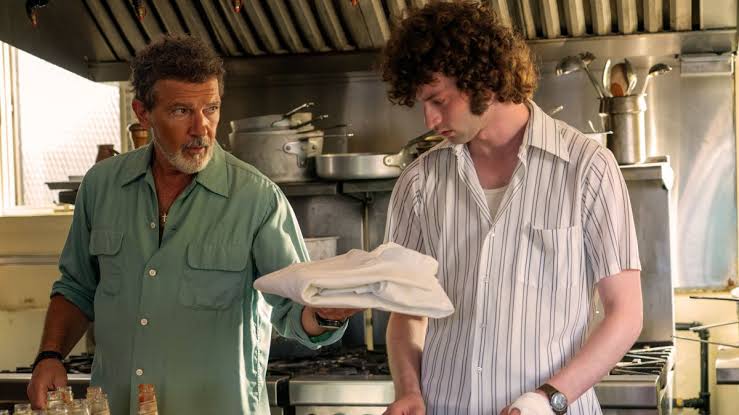
Matt Damon and Zendaya.

Standouts include John Leguizamo as his faithful servant Eumaeus, now blind; Jon Bernthal as Menelaus, a Greek king who fights alongside Odysseus, and the husband of Helen; Elliot Page as loyal servant Sinon, who is sacrificed for the war victory; Samantha Morton as the witch Circe; Himesh Patel as Eurylochus, Odysseus’ right-hand man; and Robert Pattinson as the weaselly villain, arrogant Antinous, one of Penelope’s most manipulative and power-hungry suitors.

The sprawling cast also includes Benny Safdie as the imposing Agamemnon, king of Mycenae and commander of the Greek army, Travis Scott as a bard, Mia Goth as the queen’s servant Melantho, and both Corey Hawkins and Logan Marshall-Green are bad guys teaming up with Antinous.

The master filmmaker, Oscar winner for his magnum opus “Oppenheimer,” seems to be hitting his stride tailoring stunning vistas in six countries and composing visual spectacles on IMAX cameras, the first feature film to do so. His practical effects, rather than computer-generated images, are magnificent here. The man-eating Cyclops. a massive 60-foot puppet, is terrifying, and the underworld scene, where the dead rise out of the black sand, is stunning.

Robert Pattinson as Antinous.

Along with visionary cinematographer Hoyte van Hoytema, the world-building by production designer Ruth DeJong and costume designer Ellen Mirojnick, is grand and splendid, impeccable in details.

Oscar winning editor Jennifer Lame (“Oppenheimer”) had a gargantuan task, and she made the film a lucid, thrilling watch. Swedish composer Ludwig Goransson, three-time Oscar winner (“Black Panther,” “Oppenheimer,” “Sinners”), has written an urgent, industrial score that heightens the action.

One must experience this tsunami of an epic in a theater, in full big screen glory. “The Odyssey” is to be savored and celebrated, for this is movie making at its absolute finest.

Jon Bernthal and Tom Holland.

(NOTE: It doesn’t matter whether you’ve read The Odyssey — or like me, forgotten most of what you learned about it in high school, but it helps to get a refresher beforehand, and there are plenty of sources around to get you up to speed.)

“The Odyssey” is a 2026 action-adventure-fantasy epic written and directed by Christopher Nolan, and starring Matt Damon, Tom Holland, Anne Hathaway, Robert Pattinson, Charlize Theron, Zendaya, John Leguizamo, Jon Bernthal, Elliot Page, Hamish Patel, Lupita Nyong’o, Samantha Morton, Benny Safdie, Mia Goth, Travis Scott, Corey Hawkins and Logan Marshall-Green. It is rated R for violence and some language and runtime is 2 hours, 52 minutes. It opens in theaters July 17. Lynn’s Grade: A+


By Lynn Venhaus
Five original voices made their auspicious LaBute New Theater Festival debut this year, along with the fest’s esteemed namesake with another intriguing new one-act.

The festival, established in 2013, is an active collaboration between St. Louis Actors’ Studio and Neil LaBute, the renowned playwright, screenwriter, and director of theater and film.

In its 12th year, the festival’s quality, in terms of performers and writing, remains top-notch. Six nimble actors – returning Anthony Wininger, Tyler Crandall and Xander Huber join newcomers Nick Barrows, Jade Cash and Caitlin Mickey – for an engaging exploration into the comedy and drama of being.

Presented in The Gaslight Theatre’s intimate black box as one of the company’s signature offerings every season, the line-up features authentically drawn characters by writers who have some thought-provoking points to make.

“Junk Drawer.” Photo by Patrick Huber.

This year’s assortment are delivered with aplomb by veteran directors Eric Dean White and Wendy Renee Greenwood, who helmed three apiece, and their keen perceptions are crystal clear.

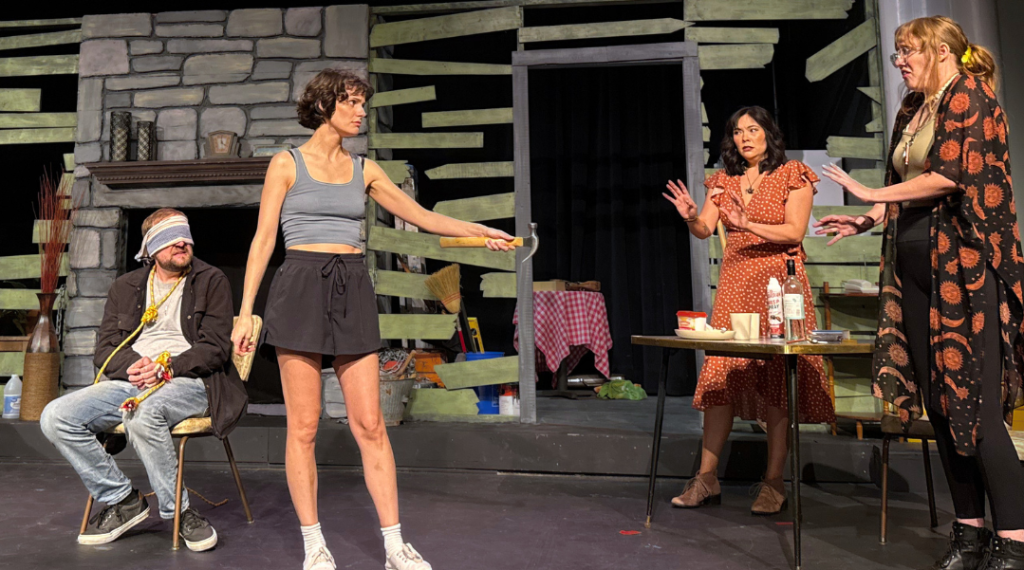
The evening of one-acts’ six titles include suspense, mystery, pitch-black comedy, whimsy, an interesting family dynamic, childhood trauma, a missing spouse, and grave diggers with a grisly task. All but one are in present day.

The well-rehearsed performers establish a comfortable rhythm in their interactions that draw us into each new world and are paired well in four two-handers and two trios.

In the clever “Junk Drawer,” playwright Erin Fitzgerald of Kentucky started on a lighthearted note. It sounds as fun as it is. White directed Cash as a penny, Huber as a poker chip, Crandall as a dried out magic marker, and Wininger as a boot strap. He leaned into the witty wordplay that made this assured piece work well and the actors joyfully gave the objects personalities like Pixar does in the “Toy Story” movies.

“Go Fish.” Photo by Patrick Huber.

Switching the mood to contentious, a slow-burn “Go Fish” followed from Cameron Michles, a New York-based playwright who doled out dollops of information as a guarded interaction occurs between Caitlin Mickey as Chloe and Nick Barrows as Whittaker, in an impressive St. Louis theater debut.

The pair meet after considerable time has passed in their lives, but has it really for these two? It’s awkward, apologetic – and icky-awful. A few of the flashback techniques aren’t clear until the final gut-punch.

When we finally realize what happened, it’s chilling. Greenwood skillfully directed so that the present encounter builds in tension, hurt, anger and regret, and the actors carefully modulated their feelings so as not to get ahead. The program gives a content warning for “depiction of violence, sexual violence, and molestation.”

In “Resurrection Men,” playwright Nicholas Dunn revived an underground and illegal body-snatching enterprise that occurred in the United Kingdom in the 18th and 19th centuries, before Parliament passed the Anatomy Act of 1832, which made grave-robbing illegal for medical schools.

This was at a time when cadavers were necessary for medical qualifications. (After that, these med schools were allowed to use unclaimed bodies at workhouses, prisons and hospitals).

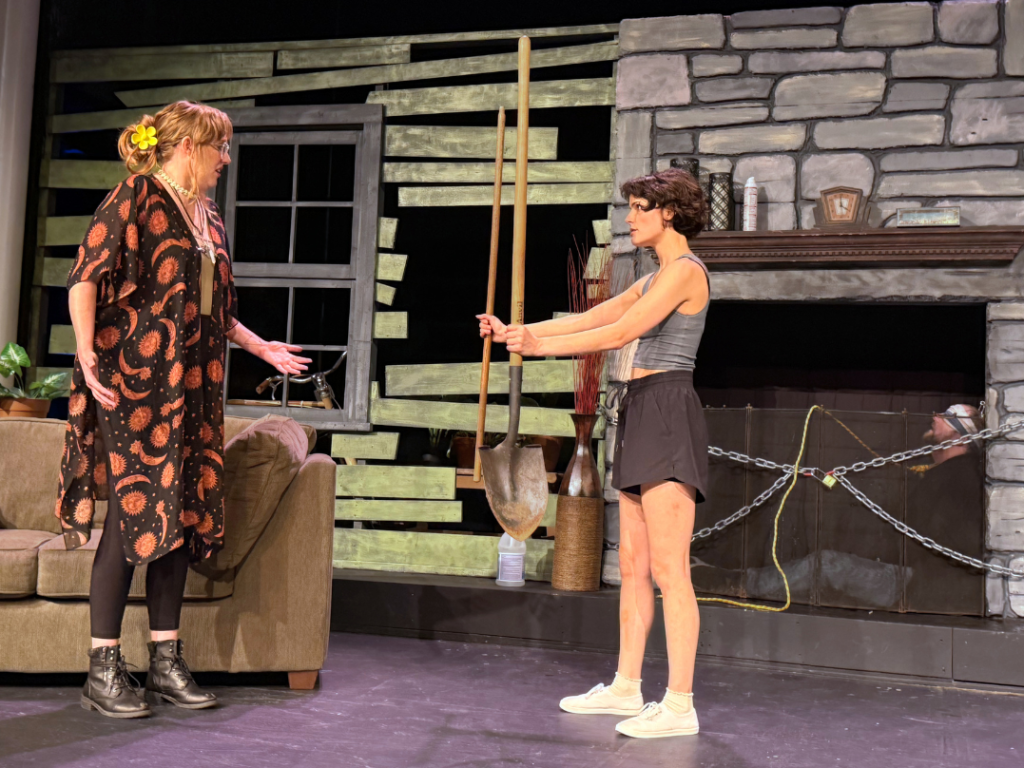
Dunn, from Salt Lake City, created a time crunch for Hatt (Wininger) and newbie Fitz (Huber), while a doctor, Knox (Jade Cash), anxiously waited for them to deliver. White kept the action moving, as the two men, looking to make a buck and on the lookout for cops or nosy tattletales, keep their shovels busy. Fitz is nervous, Hatt is the seasoned veteran, and interaction escalated until there is a surprising turn.

Huber and Wininger work well together, committed to the characters, but the play lacked the heft that other offerings possessed.

“Little Johnny Knows Things.” Photo by Patrick Huber.

After intermission, LaBute’s dandy dialogue-driven “Brunch” involved two friends – Candice (Mickey) is dealing with a cold criminal case, while Shasta (Cash) listens, feigning interest and sympathy. She asks questions, but it is what she doesn’t say that implies otherwise.

As Mickey revealed the backstory – her husband has been gone without a trace, the spotlight shifted to Shasta’s reactions. Slyly directed by Greenwood, Cash’s body language is priceless.

LaBute, a master at ambiguity, knows how to layer dark and light material, and this contemporary piece is sharply constructed with a delicious undercurrent of uncomfortable.

John Pierson’s novel entry, “Little Johnny Knows Things,” threw a cringy curve when Ryan, astutely played by Barrows, is interrupted while reading a book on a park bench. An odd Brett, coyly played by Huber, arrived with a suitcase, grinning.

Against his better judgment, Ryan engaged the peculiar young man, who pulled out a ventriloquist dummy. No doubt, this development was not on his bingo card for the day. Huber clearly relished this role, and deftly handled Little Johnny, who was meticulously crafted by Erin Knadler. This one is funny, a labor of laughs for both playwright and Greenwood.

“The Rules.” Photo by Patrick Huber.

Pierson is familiar at STLAS as a performer, director and in other roles, but playwright is a new endeavor for him. He wrote this one-act while he was a theater fellow at The Bogliasco Foundation in Bogliasco, Italy, earlier this year.

In the final segment, Domenick Scudera concocted a strong sense of time, place and characterization in “The Rules.” Scudera, who works in the greater Philadelphia area, immersed us in a family dynamic between brothers who grew up in Long Island that appears typical but is not. They are together after years apart because their father has died.

In their best performances of the night, Crandall and Wininger pull off the complex relationship between these two very different siblings in a sincere and meaningful way. Crandall is Mario, openly gay, whose sexuality was not embraced by his family. Wininger, in a consistent New York accent, established the older brother Leo as a dominant alpha male. Both have chips on their shoulders.

While Mario is more candid and expressive, tough-nut Leo started, ever so slowly, to crack. There appeared to be an opening as he tentatively confided to Mario some of his confusion, hesitancy, and fears.

White poignantly delivered the authentic interaction while the actors had the crisp timing down pat. It’s the kind of rumination on human connection where you want them all to hug it out.

“Brunch.” Photo by Patrick Huber.

This year, hundreds of submissions arrived for an 8-member panel to curate, including LaBute, who doesn’t just lend his name to this fest. Supporting new work is a noble endeavor, and the crew is as dedicated as the creatives involved year in and year out.

Stage manager Amy J. Paige demonstrated her prowess in this integral role, assisted this year by Nadya Nabulsi. As is his custom, Patrick Huber smoothly handled set and lighting designs while costume designer Amanda Brasher contributed appropriate casual looks for each scene.

One of STLAS’ most enjoyable aspects in these captivating collections is their needle drops. Their sound design is always well-suited to each one-act.

A notable harmonious team effort, the LaBute Festival accomplished this summer what it does best: Probe, question, wonder, worry, stir, inspire, enlighten, amuse and entertain in a very natural way.

St. Louis Actors’ Studio presents the 12th annual LaBute New Theater Festival July 10 to 26, with performances at 8 p.m. Thursday through Saturday and at 3 p.m. on Sundays at The Gaslight Theater on North Boyle in the Central West End. General admission tickets are available via Ticketmaster or at the theater box office one hour before show time. For more information, visit www.stlas.org.

By Lynn Venhaus

Big personalities and bigger voices fill the Muny’s expansive stage for an enthralling excursion into an exotic place that remains a timeless touchstone of American musical theatre.

In their 11th staging of “South Pacific” – a stunning tour de force in every element, the Muny meets a significant cultural moment through the vision of director William Carlos Angulo. Using the gutsier 2008 revival script, the show expands on the heightened love, intolerance and war themes.

Angulo emphasizes the two intercultural romances where couples grappled with acceptance and overcoming prejudice some eight decades ago, which resonates today. Suave Emile de Becque is a French plantation owner with a mysterious past who falls for spunky nurse Nellie Forbush, from Little Rock, Ark.

The time is 1943 when the Allies fought the Axis – the coalition of Nazi Germany, fascist Italy and Imperial Japan in World War II. The unworldly Nellie is stationed on an unnamed island where the U.S. Navy and Marines are keeping tabs on the enemy.

Taylor Louderman (center) with members of the company of the 2026 Muny production of Rodgers & Hammerstein’s “South Pacific.” Photo by Phillip Hamer

These characters populated James Michener’s short stories in “Tales from the South Pacific,” which was adapted by Joshua Logan and Oscar Hammerstein for the wartime musical, with music by Richard Rodgers and lyrics by Hammerstein. It opened on April 7, 1949, when war memories were fresh in people’s minds.

The work won the Pulitzer Prize for Drama in 1950, the first (and only musical until “Hamilton” in 2016) and 10 Tony Awards. It ran for nearly five years on Broadway until 1954, a record album was a huge hit, and a popular movie adaptation was released in 1958. The show had never been revived on Broadway until Bartlett Sher’s acclaimed 2008 Lincoln Center run, which tackled the darker themes realistically.

After Marine officer Lt. Joseph Cable arrives for a dangerous espionage mission, he is smitten by Liat, a Tonkinese woman who lives on the mystical island Bali Ha’i. As the young lovers, Michael Canu and Michaela Marfori are mesmerizing in dance sequences that Angulo has incorporated for richer storytelling. Choreographer Karla Puno Garcia has added a tender tableau that sets this production apart, a ravishing debut.

Michaela Marfori and Michael Canu in the 2026 Muny production of Rodgers & Hammerstein’s “South Pacific.” Photo by MaryKatherine Patteson, The Muny

That glorious music! Music Director Roberto Sinha conducts 29 musicians for those iconic sweeping ballads and fun ensemble numbers, so very sumptuous, starting with that fabulous overture.. Sinha returns after marvelous maestro turns in Angulo’s “In the Heights” and “Dear Evan Hansen” and is currently the music director of Broadway’s “Hamilton.”

To experience Brazilian bass-baritone Paulo Szot recreate his Tony-winning role as Emile is wondrous and breathtaking live. This is the kind of powerful operatic performance that people will still be talking about for years.

They’ll single out his magnetic renditions of “Some Enchanting Evening” and “This Nearly Was Mine” with the kind of reverence that is spoken about Yul Brynner in “The King and I,” Robert Preston in “The Music Man,” and Zero Mostel in “Fiddler on the Roof.”

Sarah Fenske, St. Louis Magazine executive editor, declared it “The Summer of Szot” after seeing him at both Opera Theatre of St. Louis as charming Signor Naccarelli in “The Light in the Piazza” and now the Muny. I’m jumping on this bandwagon too. (He’s returning to Broadway to play Lance in “& Juliet” later this month, a role he originated.)

Paulo Szot in the 2026 Muny production of Rodgers & Hammerstein’s “South Pacific.” Photo by Phillip Hamer

While a charismatic presence, he’s not the only reason to see this cherished classic. Taylor Louderman is enthusiastically welcomed back to where it all started for the Tony nominee as a teenager, combining a sunny disposition with her physicality and lovely lilting vocals as the spirited, unsophisticated Nellie. Showing genuine emotional depth, she brings out the turmoil that Nellie faces because of ingrained attitudes that affect her relationship with Emile.

Now playing a very grown-up role, she’s the epitome of exuberance in “A Cockeyed Optimist,” “I’m Gonna Wash That Man Right Outa My Hair,” “I’m In Love with a Wonderful Guy,” and “Honey Bun.” Together, Louderman and Szot have a sweet chemistry., and their “Twin Soliloquys” is silky smooth.

Not only can Canu dance ballet, but his strong tenor soars in “Younger Than Springtime” and “My Girl Back Home.” Being brought up in Philadelphia society, when he’s disgusted by his own ingrained bigotry, he erupts into the pivotal “You’ve Got to Be Carefully Taught.”

Paulo Szot and Michael Canu in the 2026 Muny production of Rodgers & Hammerstein’s “South Pacific.” Photo by Phillip Hamer

This decades-old social commentary remains impactful today, which sets “South Pacific” apart from other golden-age chestnuts. When she meets Emile’s Polynesian children, Louderman must say “colored,” which has been restored in the script. The understanding comes later. It’s a scrupulously constructed show that wants to say something.

The rest of the ensemble is flawless, with Joan Almedilla a knockout as Bloody Mary, avoiding making her a caricature, and transporting us in “Bali Ha’i.” After playing a conniving prince in “Frozen” last year, Bobby Conte returns as an animated Luther Billis, the lovable schemer who provides much needed comic relief.

It’s a pleasure to see three St. Louisans make their mark on the Muny stage, with veteran Michael James Reed as Captain George Brackett, Jeff Cummings in his debut as Commander William Harbison, and former Muny Kid Robert Crenshaw in his debut as Stewpot. Crenshaw, who lit up stages on national tours of “Ain’t Too Proud” and “The Wiz,” is fun to watch as the goofy Seabee.

Jeff Cummings (left) and Michael James Reed in the 2026 Muny production of Rodgers & Hammerstein’s “South Pacific.” Photo by MaryKatherine Patteson, The Muny

The lavish atmosphere, in contrast to the gritty war mission, is beautifully rendered in Arnel Sancianco’s lush scenic design, with the tropical touches carried through in John Lasiter’s sun-drenched lighting design and Yee Eun Nam’s video designs of breezy foliage and ocean waves. Josh Hummel crafted the sound design.

Costume designer Raquel Adorno’s lovely flowing evening gowns set an enchanting mood, with a gorgeous palette of seafoam greens and blues as well as flowery prints. The elegant party clothes contrast with the military attire of the sailors and nurses. Ashley Rae Callahan was the wig designer.

The robust singers and dancers have fun with “Bloody Mary,” “There Is Nothin’ Like a Dame,” and the Thanksgiving Follies. As Emil’s children Ngana and Jerome, Grace Moore and Josiah Paik are delightful in “Dites-Moi.”

Bobby Conte (center) and members of the company of the 2026 Muny production of Rodgers & Hammerstein’s “South Pacific.” Photo by Phillip Hamer

The cast includes Julia Aguinaldo, Tre’ Booker, Jessica Carmona, Chloe Chamberlin, Aaron Patrick Craven, Arielle Ploy Dettmer, Alex Benetiz Evans, Rachel Fairbanks, Hannah Florence, Garrick Goce Macatangay, Jake Mendes, Caylie Rose Newcom, Julian Ramos, John Ray Jr., Hayden Rivas, David Rowen, Connor Schwantes, Gordon Semeatu, Francisco Thurston, and Nicholas A. Wilkinson.

The Muny’s “South Pacific” is a snapshot of how we once were, with hope for the future.  It’s a grand glimpse of the best of times, the worst of times, and how people connect dramatically on the world arena. This exceptional cast and crew of artisans have created an unforgettable night of theater that deeply resonates and carries us away in song.

“The Muny” presents “South Pacific” on the outdoor stage from July 6 – 12. Visit muny.org for more information on The Muny’s 108th season. 

From left: Grace Moore, Taylor Louderman and Josiah Paik in the 2026 Muny production of Rodgers & Hammerstein’s “South Pacific.” Photo by Phillip Hamer

By Lynn Venhaus

With a modern sense and sensibility, local playwright John Wolbers created a warm, welcoming and wild woman’s world of the 16th century in the private chambers of Queen Elizabeth I.

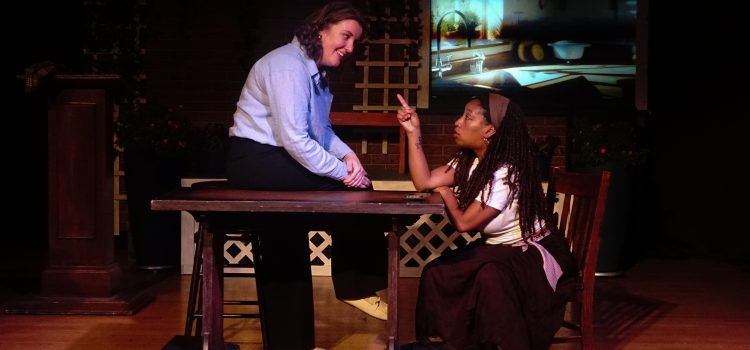
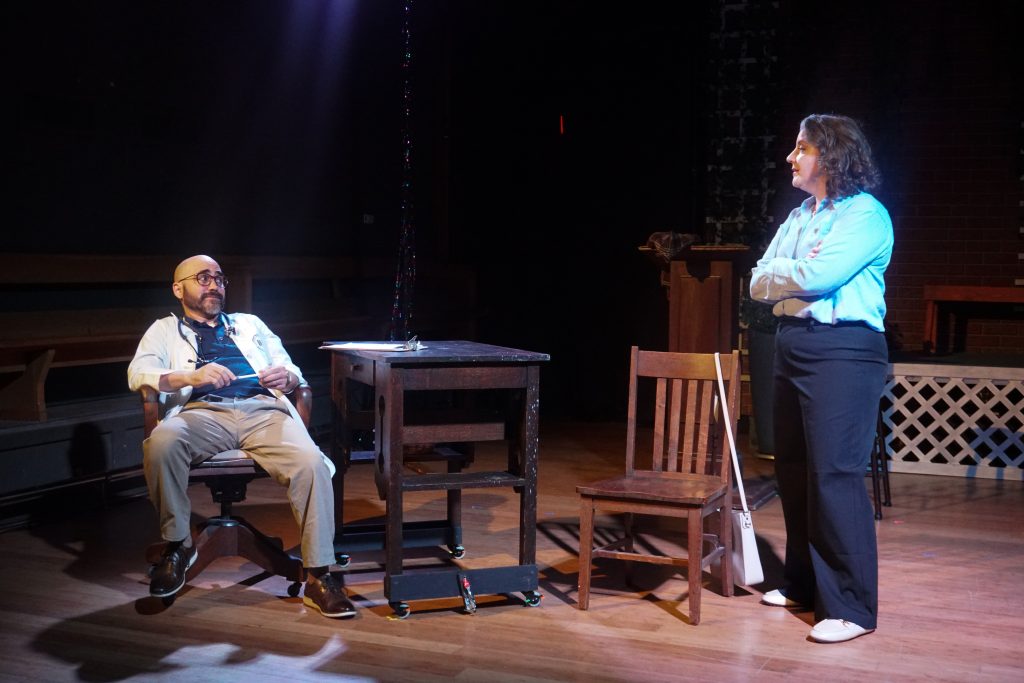
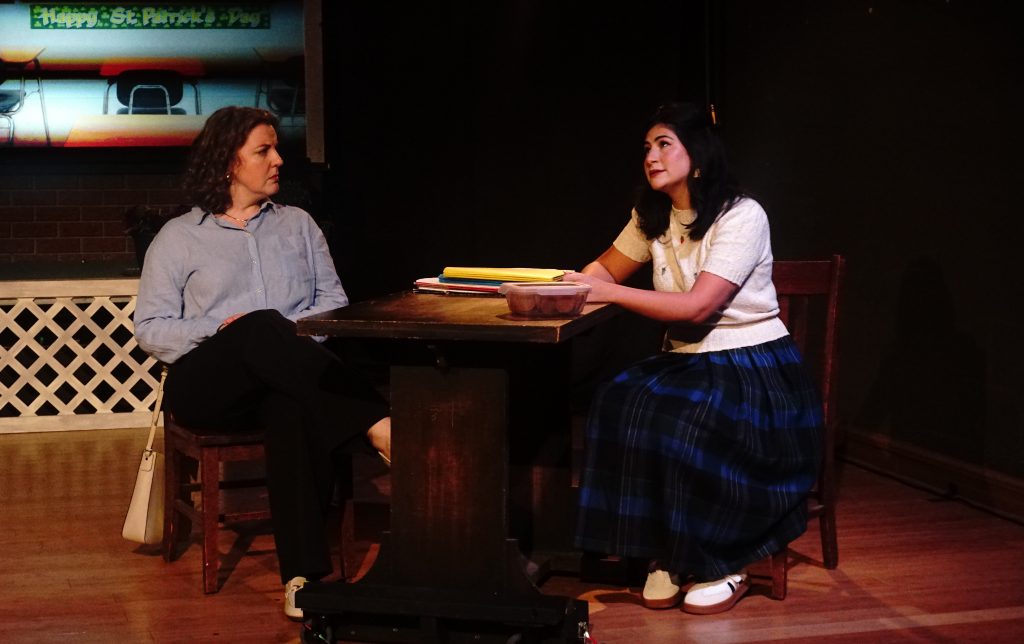
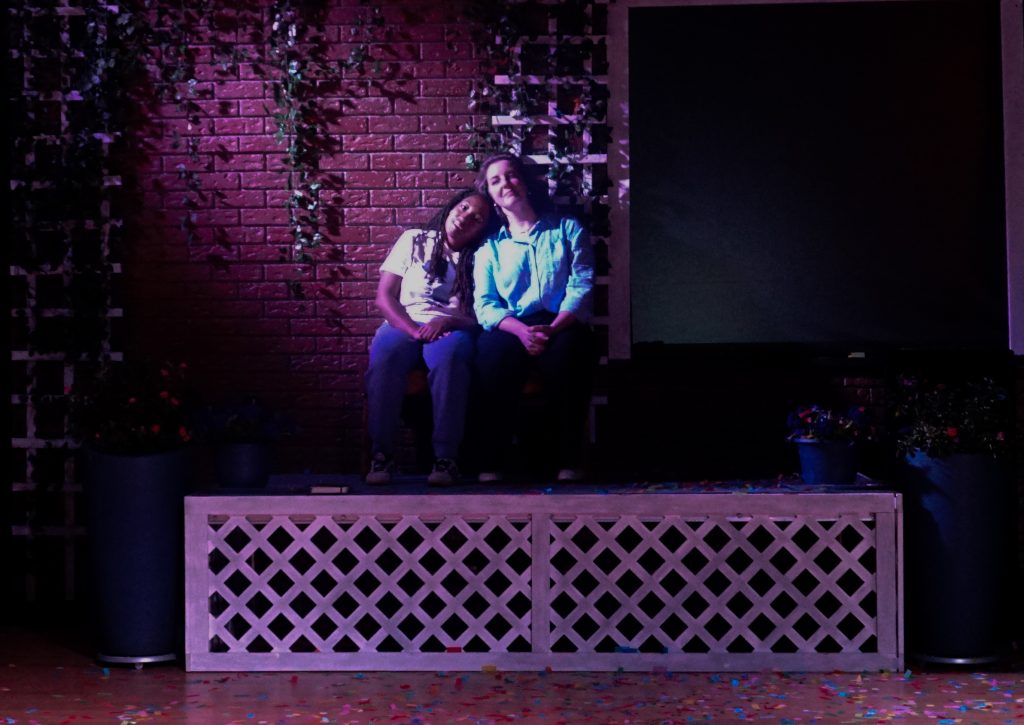
In Prism Theatre Company’s world premiere of the comedy-drama “Progress,” this is an uninhibited Bess – presented informally and not on official duty, although she prepares to meet dignitaries, ambassadors and advisors.

In discussions with his life partner Liz in 2020, he discovered an aspect of Bess’s untold story he needed to tell – that she had a savvy squad of advisors uplifting her so that her regal image would be impressive and dignified every day.

With an uncanny ability to write multi-dimensional roles for women, Wolbers has peeled back the curtain, creating a chummy workplace environment that feels lived-in and nurturing. Straight talk is how conversations are played – even if it would be TMI or NSFW in today’s parlance.

Featuring an all-star cast, these six crafty servants surround the queen in her inner sanctum. They manage her daily routine – dressing her, checking personal care, taking care of correspondence, schedule, budgets, sweet snacks and liquid refreshments.

Local treasure Michelle Hand assuredly plays the swearing sweet-and-sour “Virgin Queen” whose 45-year reign from 1558 to 1603 was viewed favorably as “Progress” and called a “Golden Age” because it brought stability, a cultural Renaissance and the rise of England as a world power.

Prone to emotional outbursts, Bess flies into a rage but then switches to warm and witty. Hand conveys the royal’s intellect, charm, and energy – and dishes dirt with glee. She’s also pragmatic when dealing with world leaders, not making hasty decisions.

KODAK Digital Still Camera

The play begins on Christmas Day in 1562, in London, at the Palace of Whitehall. Sarah Lantsberger excels as an earnest and eager newcomer, Mary, who is nervously introduced to the key ladies.

These colorful characters, all properly prepped and styled by virtuoso costume designer Liz Henning, include Nicole Angeli as right-hand Blanche, a rather stern taskmaster who is also a mother hen. Rachel Tibbetts is the pregnant Dorothy who prides herself on a good job.

Carly Uding is Sidney, who has a complex relationship with her majesty because she is the sister of childhood friend and suitor Robert Dudley.

Margeau Steinau is spicy as Kat, a crusty and blunt attendant whose husband is also on staff. She knows what’s what and who’s who and freely shares locker room talk.

The women are also given other duties to carry out and keep themselves busy when they’re not fussing and fretting. The queen delivers news of an impending bubonic plague in London, and in the second act, the women are relocated to Windsor Castle in late summer 1863, to evade the spreading infection.

They’re hot, tired, cranky and restless. Tempers flare and then cool down. The plague has everyone on high alert, and they all must learn to trust – and soothe each other.

The experienced ensemble is adept at the verbal jousting the dialogue demands, and as smart, intuitive actors, they shade their characters with personality. Wolbers laid out conflicts in those challenging times, and the women rose to their best selves when they’re with each other.

In Act II, there is an amusing dream sequence where Bess is visited by past and future queens – Steinau is Queen Elizabeth II, Lantsberger is Lady Jane Grey, Uding is Queen Boudica, Tibbetts is Queen Anne and Angeli is Queen Victoria. They were all in that elite birthright club and know some things.

The final scene jumps ahead 25 years to Christmas 1589, in London’s Richmond Palace. The queen defeated the Spanish Armada a year earlier and is more comfortable ruling. Hand demonstrates Bess’s growth, for she has marched through the fire, with the help of her loyal ladies – and they’ve changed too.

Director Trish Brown has trusted these talented performers to play well with others in a sister showcase, designed by women artisans, who convinced us of the period trappings and their predicaments. Zayana Brown is the ensemble swing, if needed.

Katherine Stepanek, scenic and lighting designer, immersed us in a cozy period piece, intimately illuminated, with aid from assistant lighting director Brianna Shipley. Leo Young was the technical director, Delaney Plank production intern, and stage manager Joy Addler (and co-producer), along with assistant stage manager Avery Harrison.

Sound designer Bryn McLaughlin also composed nicely textured music, including a lively folk song that the women often broke into, and fight choreographer Riley Capp designed moves for when things weren’t so collegial. Jenni Ryan served as dramaturg and assistant director.

This community breathed life into an engaging piece of very funny, thoughtfully executed theater that showed us how strong women can be when difficulties must be overcome, a timely message no matter from what century.

Prism Theatre Company presents “Progress” July 3-5 and July 9-12 at the Kranzberg Black Box Thearre, 501 N. Grand, St. Louis, Mo. For more information, visit www.prismtheatrecompany.org

This production contains adult language and discussion of adult content.

KODAK Digital Still Camera Nicole Angeli, Sarah Lantsberger, Liz Henning, Michelle Hand, Rachel Tibbetts, Margeau Steinau, Carly Uding, and John Wolbers.

By Lynn Venhaus

Albion Theatre’s masterful interpretation of Morgan Lloyd Malcolm’s “The Wasp,” a contemporary twisty and twisted psychological thriller, leaves the gasping audience deeply unsettled and finally able to breathe after a dramatic 90-minute rollercoaster.

Because of its many layers of secrets, lies and manipulation, Robert Ashton has directed this dark two-hander by carefully building suspense and never allowing the actors to get ahead of the material. The element of surprise is always present as Heather (Ricki Franklin) and Carla (Macia Noorman) awkwardly engage in three tense-filled scenes.

Shades of high-stakes Hitchcock abound, as conversations include tea and revelations between the two former classmates, 20 years after they’ve seen each other. At first, one assumes this uneasy encounter is because there has been no contact during these ‘grown-up’ years, and the obvious class distinctions.

But it goes so much deeper than an affluent Heather approaching blue-collar Carla, pregnant with her fifth child, with a shocking request. Malcolm’s intense and intimate 2015 play becomes an exploration of female friendships and childhood trauma.

Malcolm cleverly weaves female-centric issues with occasional humor, easily establishing characters’ personalities and motivations – but maybe our perceptions aren’t as clear-cut. Hmmm… the plot thickens.

As disturbing facts are disclosed, and a proposition gets more complicated, the chemistry between the two characters is crucial. Franklin and Noorman, both making their Albion debuts, haven’t worked together before, but that isn’t apparent in their assured portrayals and compelling interactions.

They both are riveting, expertly showing vulnerability and strength, hurt and fear, rage and worry, cruelty and mercy. At times, you can see their old schoolgirl selves re-appear in their adult shadows. With a hint of where this is going, an overwhelming feeling of dread escalates — and some surprises are still ahead.

Macia Noorman as Carla and Ricki Franklin as Heather in “The Wasp.” Photo by John Lamb.

Franklin’s refined Heather seems to have the upper hand, and appearances indicate she has a thriving career and ‘married well,’ but divulges that she is miserable in the union, ticking off her husband’s alleged infidelities and despicable qualities. Franklin, two-time St. Louis Theater Circle Award winner as supporting actress in Shakespeare comedies, has an opportunity to show her dramatic chops here.

Noorman’s streetwise Carla, obviously wary but much more complex than a stereotype, has had a rougher life, struggling financially but seemingly happy as a mother, if not as a wife. Heather is childless. Noorman, a St. Louis Theater Circle Award nominee in 2019, shows an impressive range in this challenging role.

Although narrative twists have been exposed throughout the years (the play’s been around for 11 years, but this is the St. Louis premiere), I hesitate to mention too many details in case someone unfamiliar with this show would ever see it. Let’s just say your allegiance may shift as more comes to light, as we attempt to determine who you can trust or believe. Who are you feeling sorry for as grisly details emerge?

Were they once friends, enemies or frenemies? Can you ever forgive childhood slights and mean-girl behavior, and what about unreliable memories?

The play gives off the same cunning vibes as “Sleuth,” Anthony Shaffer’s brilliant 1970 cat-and-mouse mystery that featured class warfare and toxic masculinity, but Malcolm’s modern work is distinctively feminine.

Ashton astutely sets each exchange through scenic designer Rob Lippert’s well-appointed set in the intimate black box theatre. From a small coffee shop to Heather’s posh home, Lippert’s keen eye has created a vivid world, complete with a well-manicured backyard glimpsed through a glass door.
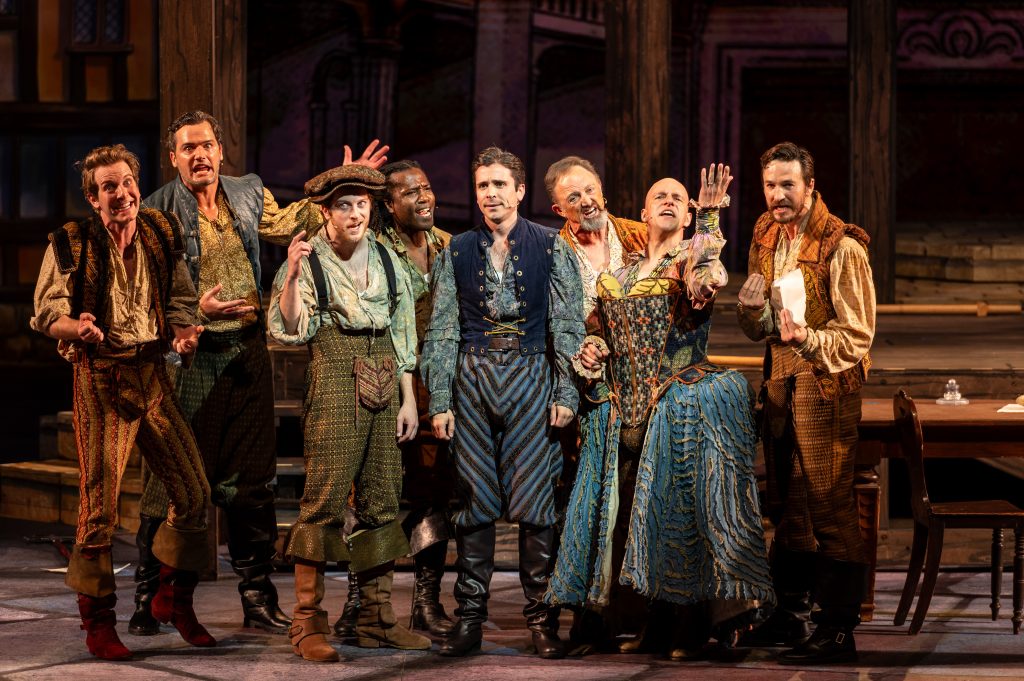
Lighting designer Kara Grimm-Denholm added to the classy atmosphere, and Tracy Newcomb’s costume designs effectively established the socio-economic status of each woman.

Ricki Franklin and Macia Noorman in a twisted cat-and-mouse game. Photo by John Lamb.

A sly reference to the titular stinger is included in Heather’s husband Simon’s framed collection of insect prints. The description is creepy, and when told, you may have an inkling of what’s ahead, but really, the script is so well-crafted and the actresses so intuitive, they keep us guessing. As both dig into a past that is far messier than first hinted at, it’s gripping and perturbing – get ready for stomach knots.

As is customary in Albion productions, the dialect is crisp and neither Franklin’s educated Brit nor Noorman’s cockney accents ever drop. Thanks to sound designer Leonard Marshell, Ashton’s tutelage and the actors’ efforts, understanding is not a problem.

Noteworthy contributions include Mo Moellering as fight choreographer, C. J. Langdon as assistant director, Rachel Klinck as board operator, Susan Wylie as stage manager and Denise Mandle as assistant stage manager, for the scene transitions are smooth and the anxious mood is never broken.

Perhaps some of the situations are contrived, but the performers are totally committed to making these characters believable and are convincing as they dredge up the distressing backstories of childhood bullying and harsh conditions.

The relationship, never solid, eventually fractures in unexpected ways. Do they go there? The performers dug deep, re-opening their characters’ wounds and showing their emotional depth in intricate, disquieting monologues.

Franklin and Noorman’s honest dynamic is key to immersing oneself in this chilling experience. Do childhood scars ever heal, and what does that say about the cyclical nature of violence? Oh, those blurred lines of life are the reason “The Wasp” has such staying power – and you’ll remember the sting.

Albion Theatre presented “The Wasp” from June 12 to 28 at the Kranzberg Black Box Theatre. This production was reviewed on June 28. The play has mature themes and adult language and runs 90 minutes without an intermission. For more information, visit www.albiontheatre.org

By Lynn Venhaus

It’s hard to say who had a better time at “Shrek the Musical” – the parents or the children, often green-clad and gleefully giggling at the daffy antics. The Muny’s annual family favorite ‘Kids Show’ delighted across generations with its irreverent humor, impressive pop vocals, and infectious energy in a funky, funny, fluffy un-Disneyized fairy tale musical.

It’s not your classic prince-rescues-princess tradition, and that’s the fun of it, what sets this storytelling apart. In the comical land of Far, Far Away, the unlikely hero is a smelly, grumpy ogre, accompanied by his chatty sidekick Donkey, his feisty true-love Princess Fiona and his merry band of misfits.

The ensemble opens with the catchy “Big Bright Beautiful World” and you’re off on an unusual adventure. Lord Farquaad demands Shrek rescue Princess Fiona from a dragon-protected tower in exchange for the deed to his swamp, for the despicable despot wants to marry her. Once upon a time wasn’t ever this raucous.
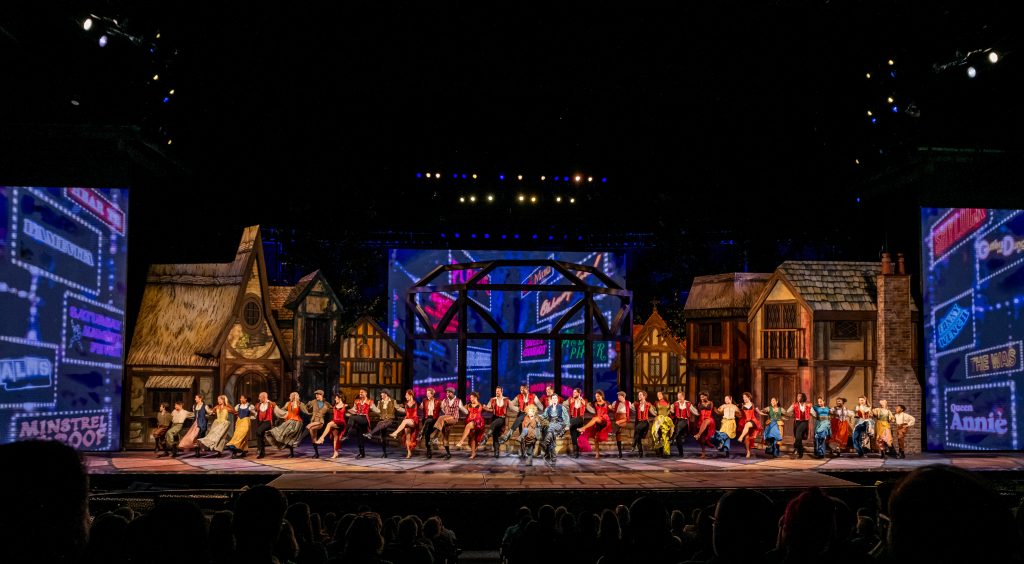
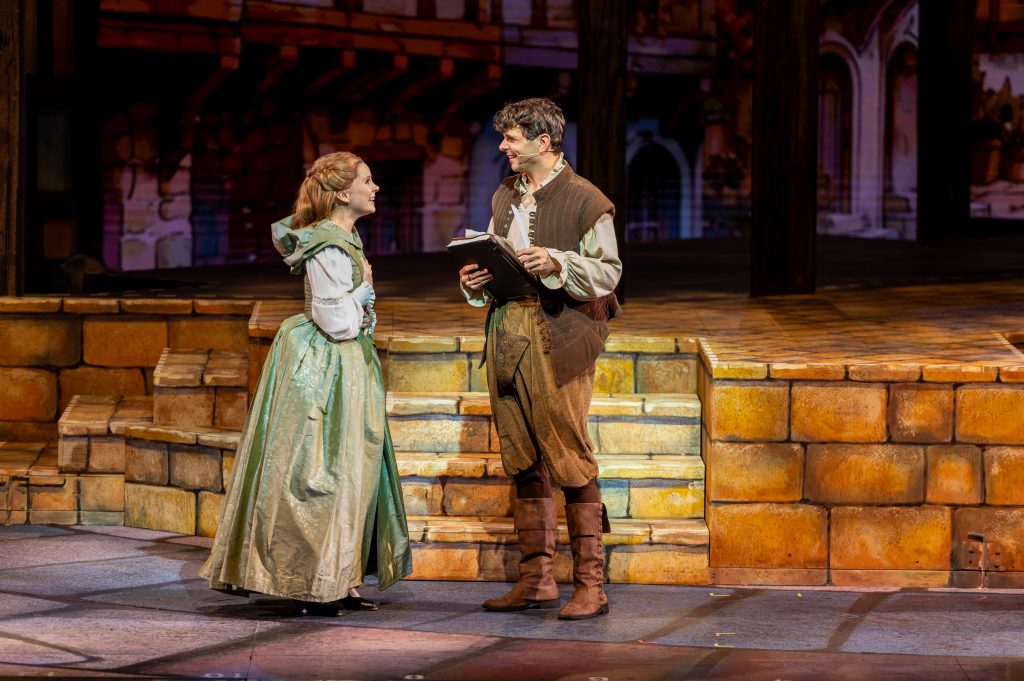
First released as an animated film in 2001, “Shrek” fractured happily-ever-after fairy tales in this DreamWorks Animation smash hit that won the first-ever Oscar for Best Animated Feature Film. Breaking industry rules and becoming a cultural phenomenon, the film adaptation of William Steig’s slight 1990 children’s picture book “Shrek!” has earned $500 million globally. It has four sequels (a fifth is due out next year), two Puss ‘n Boots spin-offs, and just announced is an Eddie Murphy-led “Donkey” spinoff for 2028.

Nik Walker (left) and Marcus M. Martin in the 2026 Muny production of “Shrek The Musical.” Photo by Phillip Hamer

Of course, Broadway beckoned. “Shrek the Musical” took off in 2008, with Tony-nominated book and lyrics by Pulitzer Prize winner David Lindsay-Abaire, whose wicked wit is apparent in this adaptation, adding more backstory and mischief. With his absurdist, blunt humor paired with Jeanine Tesori’s clever and upbeat songs, they pulled apart musical theater tropes.

Lindsay-Abaire has incorporated elements of the movie sequels, too – “Shrek 2” and “Shrek Forever After.” After the Broadway run of 441 performances, they have since revised the musical several times.

With a large fun-loving ensemble, the Muny presents a jolly good road trip to the swamp, Duloc, and beyond. In its second staging here, the first since 2013, the casting is impeccable, their performances vigorous and the whimsical world-building is dazzling by director John Tartaglia and his unconventional team of dreamers and doers, celebrating the ‘different.’

The Tony-nominated and Emmy-winning Tartaglia, who directed “Shrek” thirteen years ago – and originated the role of Pinocchio on Broadway, has infused this playful version with bigger and bolder choices but keeping his trademark heart at the center. It’s the 10th show he’s directed, and he’s very comfortable incorporating puppetry into all his visionary productions.

Tyler Joseph Ellis in the 2026 Muny production of “Shrek The Musical.” Photo by Phillip Hamer

After all, he was promoted several weeks ago to be the vice president of development and production at The Jim Henson Company, focusing on television and live theatrical projects. He serves as the primary creative supervisor for the Fraggle Rock brand (and started his career at “Sesame Street.”)

The magnificent giant pink fire-breathing Dragon is a stunning addition.  Designed by James W. Wojtal Jr. and his team, with Eric Wright of Puppet Kitchen the puppet director, five puppeteers create magic on stage. Jim Henson’s Creature Shop designed and built Gingy, the dancing rats and the exploding bird. 

Maintaining the Disney departure feel, Tartaglia followed through by envisioning a grungier, not gleaming, kingdom, but also favored a lively, captivating 90s glam-rock concert look, with a nod to punk rock, too.

It reminded me of late ‘60s and early ‘70s television variety shows like “The Sonny and Cher Show” and “The Smothers Brothers Comedy Hour” with sparkly high-energy performers and cheeky humor.

Marcus M. Martin and Salome Smith in the 2026 Muny production of “Shrek The Musical.” Photo by The Muny | Emily Santel

The well-integrated designs add to the showbizzy and make-believe worlds, including musical Easter eggs that subvert the usual tropes (Can you spot “Les Miserables,” “A Chorus Line,” “Gypsy,” “The Lion King,” “Wicked” and “Chicago”?). Nothing’s going to bring him down, Lord Farquaad sings!

Adam Koch’s vivid set design incorporated a new-to-the-Muny technique, using a screen to great effect, especially when Donkey and Fiona have a heart-to-heart in a ‘cave.’ His grid-and-forest design took us immediately into an interesting new world.

The exceptional trio of Nik Walker, Marcus M. Martin and Kara Lindsay headline as Shrek, Donkey and Fiona, and corralled us into their corner from their entrance, with deeply expressive voices, crisp comic timing and tangible chemistry.

Delightful Troy Iwata once again raises the bar on comical scene-stealing performances. Previously the guffaw-inducing housekeeper Jacob in last year’s “La Cage Aux Folles” and adorably amusing as beat-to-a-different drummer Ogie in “Waitress,” he makes the most of tyrannical narcissist Lord Farquaad and his shortcomings.

Troy Iwata (as Lord Farquaad) and the company of the 2026 Muny production of “Shrek The Musical.” Photo by Phillip Hamer

His sheer physicality is mind-boggling, cavorting by wearing a special costume with tiny legs attached and primarily walking on his knees. His “What’s Up, Duloc!” and “Ballad of Farquaad” are hilarious, as are his farcical movements.

Add a zany Aymee Garcia as outspoken Gingerbread Man, aka Gingy, and a spry Tyler Joseph Ellis, who hits the right falsetto notes as rabble-rouser Pinocchio, to the ‘social outcast’ mix. Mighty Salome Smith is a showstopper as the booming voice of the Dragon, belting out “Forever” like a Dreamgirl.

All the principals, except for Iwata, are making their Muny debut. The peppy ensemble, a mix of vets and newbies, is very strong – and busy. They’re up to the rigorous routines that dynamic choreographer Patrick O’Neill, associate choreographer Bryan Thomas Hunt and assistant choreographer Kelly Sheehan challenge them with, and it shows in the major dance numbers: “Story of My Life,” my favorite “Freak Flag” with its winking at “Les Miz,” “What’s Up, Duloc!” and the glorious tap routine “Morning Person.”

Kara Lindsay in the 2026 Muny production of “Shrek The Musical.” Photo by The Muny | Emily Santel

Martin has fun leading the spirited divas Three Blind Mice (Monique Churchill, Kylie Edwards and Abby Linderman) in the R&B “Make a Move.” Inserting “I’m A Believer” from the movie for the wedding reception dance-party finale is as jubilant a curtain call as can be. Another catchy visual by inventive video designer Kylee Loera includes photo booth snapshots.

In his 18th show as music director/conductor, master maestro Ben Whiteley leads 24 musicians, and keeps the joyous tempo on track, with fluid orchestrations throughout.

For her 14th show, costume designer Robin L. McGee, a Highland, Ill., native, created an eye-popping assortment of outfits, based on original costume design by Tim Hatley. Just look at the close-up detail in production photos, making the fairy tale characters recognizable, but also able to easily move.

Jeff Knaggs’ wig designs completed the look, and those who helped with padding and prosthetics deserve shout-outs too. Lighting designer Jason Lyons and sound designer Joshua Hummel worked in tandem to capture the atmosphere, and the human noises had to be perfectly timed, as did the swamp sounds.

Salome Smith (above), Marcus M. Martin and the company of the 2026 Muny production of “Shrek The Musical.” Photo by Phillip Hamer

Now, there is frequent use of potty humor, so you are warned – particularly fart jokes. “I Think I Got You Beat” is an outrageously silly flatulence and burping contest between Shrek and Fiona.

Skilled at physical comedy, the ensemble also included Mathew Blasio, DeShawn Bowens, Matthew Davies, Ryan Fitzgerald, Matt Gibson, Jack Gimpel, Shelby Griswold, Michael Harp, Gwen Hollander, Sean McManus, Shelby Ringdahl, Trevor Michael Schmidt, Kelly Sheehan, Caitlin Stebelman and Jonah D. Winston.

They appeared as such familiar childhood characters in forests and fauna – Pied Piper, Fairy Godmother, Peter Pan, Wicked Witch, Tweedledum, Mama Bear, Ugly Duckling, Big Bad Wolf and others.

The company was joined by the adorably costumed Muny Kids and Teens youth ensembles. Fine young performers Solomon Rosenthal and Lake Schultz play Young Shrek and Young Fiona, while Amelie Lock was Teen Fiona. The trio of Fionas combine for the poignant “I Know It’s Today,” yearning for their escape.

Amelie Lock, Kara Lindsey, Lake Schultz. Photo by_Phillip Hamer

In such duets as “Don’t Let Me Go” and “Travel Song,” Walker and Martin show their mapcap skills, and when paired with Fiona in “This Is How a Dream Comes True” and the anthem “Who I’d Be,” it calls for heightened emotions.

The most important takeaway is the show’s message about self-acceptance. Some songs focus on inner beauty, self-worth and being comfortable in your own skin. Shrek’s a-ha moments include “When Worlds Fail,” “Build a Wall” and “Beautiful Ain’t Always Pretty.”

While the songs are melodious and superbly delivered, some of the numbers seem repetitive, stretching out the inevitable, and these ballads, while heartfelt and moving, created some restlessness from the little ones around me. The musical’s structure has some pacing issues, but this cast kept it as breezy as possible.(Special mention to stage manager Larry Smiglewski). It is a 2.5-hour experience with intermission.

In “Shrek the Musical,” we can still BELIEVE in the comforting magic of fairy tales, and that everyone is worthy of love and friendship. With “biggish” ideas, the Muny has crafted a refreshing show that’s suitable for all – on two different levels. For adults, the parodies and un-cutesy theme land while the kids can revel in the slapstick and goofy characters.

Aymee Garcia (Gingy puppeteer), Troy Iwata (as Lord Farquaad) and the company of the 2026 Muny production of “Shrek The Musical.” Photo by Phillip Hamer

The Muny presents “Shrek the Musical” from June 25 through July 2 nightly at 8:15 p.m. at its outdoor theatre in Forest Park. For more information, visit www.muny.org

THe company of the 2026 Muny production of “Shrek The Musical.” Photo by Phillip Hamer

By Lynn Venhaus

In a modern satire on parenting, social graces and the notion that polite society is merely a thin veneer, “God of Carnage” becomes a living room throwdown in the hands of a murderer’s row of talent and razor-sharp execution at New Jewish Theatre.

Think of it as a rambunctious comedy of manners – without the manners. This relationship play, where two upper-middle-class couples meet after a playground fight between their 11-year-old sons, will get really ugly – and hilarious.

All pros, the dynamic quartet offer a master class of limber verbal and physical exchanges. Alan and Annette Raleigh (Nick Freedman, Bridgette Bassa), contrite, arrive one afternoon at the Novaks (Joel Moses, Christina Rios), uneasy. Henry Raleigh hit Benjamin Novak with a stick, knocking two teeth out.

For the next 90 minutes, the civilized discussion unravels from courteous into chaos, with shrewd characterizations that expose these upwardly mobile sophisticates’ immaturity, hypocrisy and true nature.

Christina Rios and Joel Moses are Veronica and Michael Novak. Photo by Jon Gitchoff

Playwright Yasmina Reza earned her second Tony Award for Best Play for its Broadway debut, translated from the French by Christopher Hampton, in 2009, following her critically acclaimed “Art” in 1998. The all-star ensemble was nominated: Jeff Daniels, Hope Davis, James Gandolfini and Marcia Gay Harden, who won best supporting actress.

This is the first time New Jewish Theatre is tackling one of the French Jewish playwright’s celebrated shows. And this cast of local all-stars are paired well, bouncing off each other with a natural rhythm, keeping the witty dialogue sharp and the action fast paced.

These ill-will games are fluidly directed by Gad Guterman, whose clear-cut vision escalates the tension as pretense crumbles and the gloves come off in the Brooklyn home.

Rob Lippert’s well-appointed set gives the Fab Four adequate room to nimbly move, and each has their stand-out meltdowns. Alan is a corporate lawyer, Annette in wealth management, Michael a wholesaler and Veronica a writer.

Nick Freed and Bridgette Bassa are Alan and Annette Raleigh. Photo by Jon Gitchoff.

Even though superficial, the initially polite adults become openly hostile and judgmental as conflicts build. The awkwardness is palpable; the social niceties start falling away. They compliment Veronica on her clafouti, a French baked fruit dessert she made from scratch, talk about their careers and life in their affluent Cobble Hill neighborhood. Then, things take a turn.

The actors dig in as the grown-ups don’t take long to get primitive – misinterpreting phrases, defending meanings, and boldly stating opinions. Rum flows, marital issues surface and the tact disappears. Better judgment goes out the window.

Nick Freed deftly captures Alan’s smugness and self-importance as the preoccupied attorney, constantly distracted by taking calls about a problematic client in a high-profile case. His wife, Annette, is polished but frazzled, trying to diffuse misunderstandings at first. In this role, Bridgette Bassa boldly takes the driver’s seat after she gives up, exasperated, and lets loose.

As Veronica, Christina Rios portrays the sanctimonious control freak host. She writes pretentious books focused on social causes, and projects a superior attitude that contrasts with her husband Michael’s seemingly more easy-going nature. But ever so cleverly, she gets sassier and her moods swing farther.

The reserved bottle of rum comes out. Photo by Jon Gitchoff.

As the gruffer dad, Moses attempts to be agreeable but is hamster-shamed when he gets rid of his daughter’s beloved pet and becomes defensive right away. At first, he seems to choose his words more carefully, but then adroitly strips away any liberal pretense.

As they argue, Rios picks her battles, and her clashes with Moses rise on the DEFCON scale – so madcap and raucous. They both are such skilled performers in movement, as are Bassa and Freed, that the free-for-all is a master class in over-the-top antics. Special nod to fight choreographer John Wilson, for the staging is quite a workout.

The men, in a bro-bonding way, gang up on the women as alliance shifts, pointing out animalistic instincts. It is Alan who mentions his belief in the God of Carnage – “He has ruled, interruptedly, since the dawn of time.”

Getting metaphorical, Reza is taking aim at the primal and violent nature of humanity that we are born with, our tendency toward aggression and self-interest. Despite modern education and culture, when those artificial societal norms masks are torn off, the true instincts can surface.

The Novaks spitefully go at it. Photo by Jon Gitchoff.

Hence, the digression into childish behavior, appearing like playground bullies as attacks become personal, and a wild night ensues. Rather than just a battle royale, it offers smart food-for-thought: When our ideas are challenged, how do we react because in our everyday lives, we all deal with difficult people and situations.

The technical aspects marvelously enhance the engaging experience, with lighting design by Jayson Lawshee-Gress and sound design by Kareem Deanes that is beautifully timed, especially the frequent cell phones — Kudos for picking “The Imperial March (Darth Vader’s Theme)” for Michael’s mother’s ringtone!

Costume Designer Michele Friedman Siler has chosen the ideal socio-economic status wardrobe for each character, down to the accessories, and props supervisor Laura Skroska has selected a colorful assortment of hospitality items for eating and drinking. (I particularly liked Veronica’s Frida Kahlo socks).

Christina Rios and Bridgette Bassa share pleasantries. Photo by Jon Gitchoff.

Because of the cast and crew’s high-level of commitment, the explosive rollercoaster-like proceedings come across effortlessly on stage, when in reality it took an amusement park-sized dedication to get the tempo, timing and storytelling arranged so precisely.

This outstanding production of “God of Carnage” maintains momentum and relevancy — and is laugh-out-loud funny. (You may have heard me on Thursday, June 25).

New Jewish Theatre presents “God of Carnage” June 11 – 28, which runs at the J’s Wool Studio Theatre (2 Millstone Campus Drive, St. Louis, MO 63146). Performances are on Thursdays, Saturdays, and Sundays. Showtimes and tickets are available by phone at 314.442.3283 or online at jccstl.com/njt

Bridgette Bassa gets feisty with Nick Freed. Photo by Jon Gitchoff.

By Lynn Venhaus

A messier, edgier alien superhero has arrived in “Supergirl,” with all its expected over-reliance on CGI visual effects and its anticipated female-forward power dynamic. What is surprising is Milly Alcock’s spunky, punky portrayal of the party girl from Krypton.

Alcock, who portrayed Princess Rhaenyra Targaryen in the first five episodes of HBO’s “House of The Dragon” prequel to “Game of Thrones” and as insecure sister Simone in Netflix’s limited series “Sirens,” brings considerable heart and vulnerability to Kara Zor-El’s backstory.

The origin story is in a flashback detailing  her solo grief-stricken journey to Earth. An only child, her parents (Emily Beecham, David Krumholtz) became terminally ill when they were sent to live in Argo City after Krypton’s demise. Her father is Zor-El, brother to Superman’s father Jor-El.

Alcock’s present-day Kara is angsty, sassy, and sarcastic, and needs to find a compelling reason to put the suit back on and do good for mankind. Instead, she  stumbles and mumbles through life only clad in a Blondie t-shirt and a rumpled trench coat until she is called upon to be heroic. Her self-destructive tendencies have masked her pain and she questions her purpose. 

Kara Zor-El lands on Earth to be welcomed by cousin Kal-El.

She must rise to her destiny when she reluctantly joins forces with Ruthye (an impressive Eve Ridley), whose family was slaughtered by the monstrous villain Krem of the Yellow Hills (Matthias Schoenaerts).

As the sole survivor, she seeks vengeance. Kara reluctantly takes her under her wing on an interstellar journey, where they planet-hop between red, yellow and green-designated planets.

Hot on their trail, Krem, devoid of any humanity, injures Krypto, Kara’s beloved rascally pet, with a poison dart. Supergirl has three days to find the antidote, so that ramps up her motivation. The scalawag bounty hunter Lobo (colorful Jason Momoa) becomes an unlikely ally.

.As a follow up to DCU’s “Superman” reboot last summer, this “Supergirl” presents a different, grittier spin on Clark Kent’s younger first cousin (eight years apart). Magnetic David Corenswet returns as the noble Man of Steel, and he’s a terrific addition to James Gunn’s new vision for the DCU.

Milly Alcock as Supergirl with her beloved pet Krypto.

The return of fan-favorite Krypto is another welcome sight. As the clock ticks, Ruthye becomes a wily companion, and anti-hero Lobo steals every scene he’s in as an “immortal” with glowing eyes and a big, bad, brassy demeanor.

The entertaining actor, best known as DC’s “Aquaman,” is now a go-to for extended cameos in action films in the same way Jack Black shows up in comedies to add his over-the-top sauce.

With his hulking physique, gravelly growling voice, and riding a tricked-out motorcycle, Momoa fits into this grimy aesthetic that resembles the chaotic “Mad Max: Fury Road” and the irreverent “Guardians of the Galaxy.” The film features a visually striking motley crew of space creatures that look like an even gnarlier collection of “Star Wars” cantina revelers.

This renegade-like adventure is capably directed by Craig Gillespie, who helmed such standout darkly comedic films as “I, Tonya,” “Cruella,” and “Dumb Money” in recent years, after his breakout indie “Lars and the Real Girl” that’s among his eclectic resume..

Waiting for a bus.

Based on Tom King’s 2021-22 comic book mini-series, “Supergirl: Woman of Tomorrow,” the screenplay was written by Ana Nogueira, who focused on emotional depth, cheeky wit, a found-family connection, and an underground vibe. Where the story is weakest is its villain, Krem.

Supergirl first showed up in a DC comic in May 1959, created by Otto Binder and artist Al Plastino for the story “The Supergirl from Krypton.” If you are unfamiliar with the source materials, no worries. The plot isn’t so dense that you can’t figure out what drives the super-powered Kryptonians to save the universe, one epic battle at a time.

St. Louis native Gunn, creator of Marvel’s vastly successful “Guardians of the Galaxy,” took over the reins of DC Studios as co-chair and co-CEO with Peter Safran in 2022, and he is the creative leadership for the film, TV and animation slate.

As writer-director of the 2025 “Superman,” Gunn restored the iconic American superhero to his altruistic roots and did considerable world-building. He also teased the new Supergirl coming this summer, when Kal-El was headed for the Fortress of Solitude, and she returned to fetch Krypto.

Supergirl (Milly Alcock) face to face with villain Krem (Matthias Schoenaerts).

Gunn is up next writing and directing “Superman: Man of Tomorrow,” which is set for release July 9, 2027, with Corenswet back and Nicholas Hoult reprising his role as arch-villain Lex Luthor.

Memorable villains are always key to how good a movie holds up, and Krem is bland. It’s not that Schoenaerts isn’t a good actor, because the Belgian has been noteworthy in acclaimed international films (“Bullhead,” “Rust and Bone”), as a thug in the vastly underrated “The Drop” and as a prisoner seeking redemption in “The Mustang.”

But written as a one-note demonic space pirate, he’s not interesting. His physique is imposing as a sadistic killing machine, but there is not much to work with here.

Jason Momoa as “Immortal” antihero Lobo.

The last “Supergirl” live adaptation feature was in 1984, as a spin-off of Christopher Reeve’s Superman movies, and bombed, with Helen Slater in the title role.

Three decades later, Supergirl re-appeared as a popular television series on the CW from 2015 to 2021, starring Melissa Benoist. Since then, the character appeared as an alternate-universe Kara in the crossover 2023 film “The Flash,” played by Sasha Calle.

While this “Supergirl” is not without flaws, it still is a promising start to the new direction, and has enough characters to care about, particularly the lovable scruffy floppy-eared, white furry mutt, and the resourceful and determined Ruthye. The female protagonists both deal with trauma in an identifiable way.

Milly Alcock as Kara Zor-El and Eve Ridley as Ruthye Marye Knoll.

“Supergirl” is a 2026 sci-fi action-adventure directed by Craig Gillespie and starring Milly Alcock, Matthias Schoenaerts, Eve Ridley, David Corenswet, Jason Momoa, Emily Beecham and David Krumholtz. It’s runtime is 1 hour, 47 minutes, and is rated PG-13 for sequences of strong violence, action, language, and smoking. It opens in theatres June 26. Lynn’s Grade: B